Examples showing the benefits of including unused runway in
Runway/Obstacle analysis (New Version)
Clearing an obstacle:
In this example the maximum takeoff weight allowed
was determined as follows:
The program searches for the highest possible aircraft
weight which allows the aircraft
to clear the obstacle. In this example, it was determined
that this optimum weight
(10915 lbs) will result in an accelerate-go distance
of 4575 feet, leaving 1045 feet of
unused runway. Add this unused runway distance to the
obstacle distance of 1850
feet and the total distance from the end of accelerate-go
portion to the obstacle is now
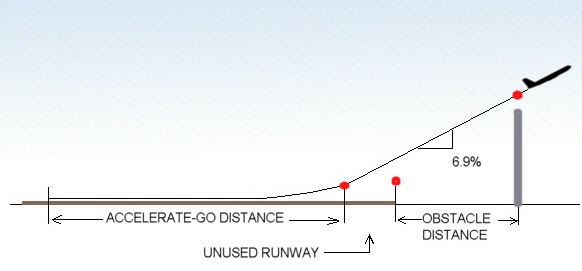
2895 feet. Thus, the minimum takeoff gradient required in
order to clear this particular
obstacle is 6.9% (height of 200 feet (from 35 ft AGL to 235
ft AGL) and distance of
2895 feet). This is illustrated in the diagrams below.
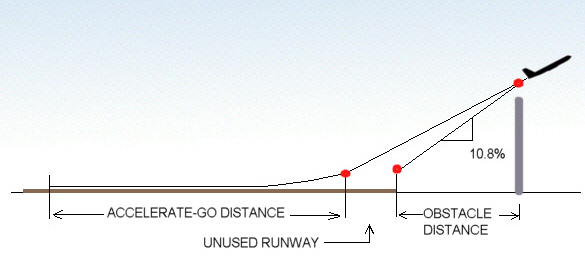
Without taking into account the unused runway, the
minimum required takeoff
gradient is 10.8%. This aircraft cannot achieve
this climb gradient under the current
conditions.
Thus, takeoff is not possible.
Copyright
© 2009-2011 AFM Solutions
Taking into account the unused runway, the
minimum required takeoff gradient is 6.9%
allowing the aircraft to takeoff with a weight of
10915 pounds and safely clear the obstacle.
A keyboard shortcut: While inputting takeoff fields
press the “F1” function key to open the
SID
Or Obstacle input data fields
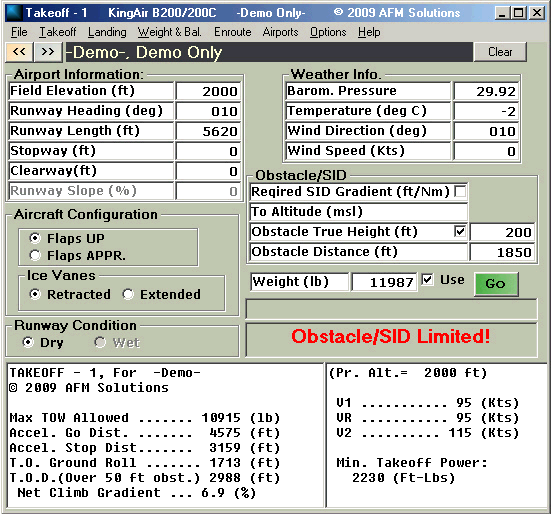
An example in Runway/Obstacle analysis including Unused Runway Distance:
Copyright
© 2009-2011 AFM Solutions
The program determined that the intended weight of 11987 lbs had to be brought down to
10915 lbs in order to safely clear this obstacle.
Note that the Takeoff Climb Gradient chart does
not provide any information regarding Headwind
Corrections or Tailwind Corrections. The Climb
Gradient values used in computations are zero-wind values.