King Air C90B
(Model C90A)
See also King Air C90 (Serials LJ-668 thru LJ-1010, except LJ-670, LJ-986 and LJ-996)
Takeoff Landing Enroute W&B Main
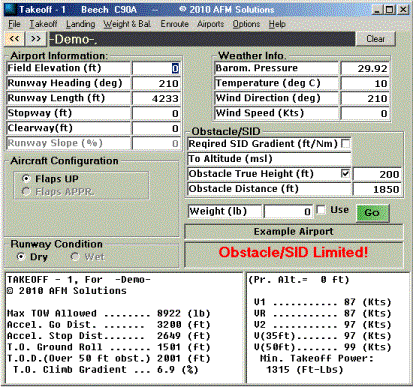
(The takeoff ground roll is approximately 75%
of the takeoff distance over a 50-foot obstacle.)
Clearing an obstacle:
In this scenario the maximum takeoff weight allowed
was determined as follows:
The program searches for the highest possible aircraft
weight which allows the aircraft
to clear the obstacle by a minimum of 35 feet. In this
example it was determined that this
optimum weight (8922 lbs) will result in an accelerate-go
distance of 3200 feet, leaving
1033 feet of unused runway. Add this unused runway
distance to the obstacle distance
of 1850 feet and the total distance from the end of accelerate-go
portion to the obstacle is
now 2883 feet. Thus, the minimum takeoff gradient required
in order to clear this particular
obstacle is 6.9% (height of 200 feet and distance of 2883
feet). This is illustrated in the
diagrams below.
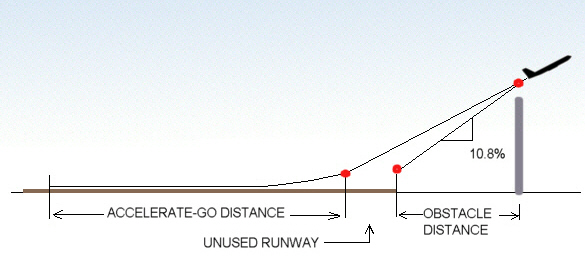
Without taking into account the unused runway, the
minimum required takeoff
gradient is 10.8% In order to achieve this climb
gradient the takeoff weight would
have to be reduced to 7220 lbs. At this low weight
one is not fully taking advantage
of this airplane’s capabilities.
Copyright
© 2009-2010 AFM Solutions
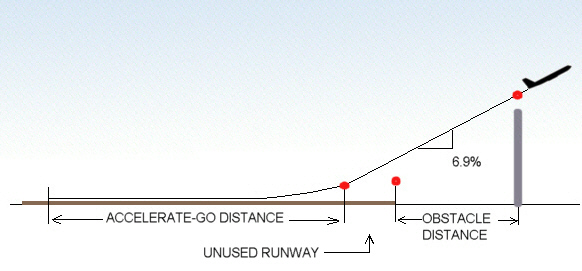
Taking into account the unused runway, the
minimum required takeoff gradient is 6.9%
allowing the aircraft to takeoff with a weight of
8922 pounds and safely clear the obstacle.
Be aware that the Takeoff Climb Gradient chart
does not provide any information regarding Headwind
Corrections or Tailwind Corrections. The Climb
Gradient values used in computations are zero-wind values.
While the obstacle true height is 200 feet, the program does
not subtract 35 feet from the obstacle
height for added safety considerations. This feature can be
modified per user request.
A keyboard shortcut: While inputting takeoff fields
press the “F1” function key to open the
SID
Or Obstacle input data fields
Copyright
© 2009-2012 AFM Solutions